Showing posts with label injury. Show all posts

Thursday, September 15, 2022

When Advice Is Worse Than None At All

Boulder is a place that attracts a surprising number of fakes. The types of imposters here in Boulder are ones who cling hard to a label and boast about who they are but, in reality and probably without realizing it, show they are the opposite of whatever identity they claim to be. The yoga community is rife with people who like to look down on others, despite the philosophy of the practice in which they engage including teachings related to detachment, self-awareness, and spiritual knowledge, traits that, in theory, lead people to become better versions of themselves, not ones who prompt judgment and hubris. Here, yogis like to flaunt their fancy apparel and the fact that they attended Burning Man more than they focus on any spiritual advancements. 

People who genuinely engage in the practice of yoga, on the other hand, are the opposite. They don't have to flaunt anything or use any kind of signaling, virtue or otherwise, to be admired. Being adored is not their goal. Their activity becomes part of who they are and isn't seen as good or bad. It just is. It's the same as if they didn't engage in the practice, because who they are is more important than what they do, how they dress, or how they look. They don't have to advertise what they do to anyone in order to feel content in the world.

It's easy to forget some simple rules of life -- you don't have to put on an act in order to be appreciated, and contentment isn't found outside yourself -- with the mess that occurs on social media, everyone screaming for attention. One of the best yoga teachers I ever had was overweight according to standard American weight charts, smoked, rode a motorcycle, and played in a rock band. He never wore flashy clothes and didn't have to adhere to any American stereotypes around the discipline; he was just really good at yoga and a top-notch instructor. He's a model for what it means to be authentic.

I view the running community at large the same way I look at the yoga community here in Boulder. Within the sizeable group, there are pockets of individuals who do good, sometimes really good things. They are inspirational and out to become the best version of themselves. These are people who create inclusive communities or foundations, or are skilled at what they do, or are simply kind and thoughtful. Most of these types are athletes or coaches, or people who want to do good in the world and limit their time on social media.

When it comes to running, Addy Bracy and also the Roots Running crew set a great example. Then there are a few who can balance a hearty dose of social media with a life away from the computer. Sage Canaday comes to mind. His social media content is informative, but he has fun with it and doesn't take himself too seriously. In sharp and disappointing contrast are the many self-appointed experts who like to offer bite-sized bits of imagined wisdom without really saying much. The ones who make up this last group are primarily writers, fans of the sport, and influencers. 

Whether it's on social media or in a published article, people in this last group love to pretend the content they are sharing is fresh and new, but it's almost always information that has been presented before, usually without reference. Condensing complex ideas into pithy little sayings is rarely helpful, and using hyperbole to the point of absurdity is equally unnecessary and uninteresting. Stephen King cautions against writing past your ability, yet so few are willing to take his advice. They think using as many adjectives as possible is the way to go, even if the modifiers are used incorrectly or make readers cringe. Don't fake being a virtuoso if you can't play the scales. Instead, work on your technique and try to enjoy the process. That's what I do. 

Many errors could be easily corrected in published material if a qualified editor would step in, but running magazines seem to have a shortage of competent editors, Runner's World being the occasional exception, and anything by Alex Hutchinson being the consistent exception. Really, though, it's not fully the responsibility of the writer to offer up a perfect final piece. It’s unfortunate that anything goes these days. 

Some of the more bizarre life and training takes I have seen online and in publications recently include the following:

1) A coach claimed that rest is different for everyone. He suggested that for some it’s a day off, but for others it’s a 15-mile run. A few of us corrected him on Twitter, saying that 15 miles, even at the most leisurely pace, isn’t even a recovery day since anything that long is going to take a toll on your body. It can be an “easy” day for some but definitely not a rest or recovery day, even if it might seem like a piece of cake to very fit individuals. Rest is rest and means just that. “Active rest” means engaging in low-intensity activity for a limited duration and allowing your body to recover, not breaking it down further. 

2) On Twitter, a well-known athlete announced that there’s no such thing as overtraining, only under-fueling or not getting enough rest. My response to that is: bullshit. Overtraining is doing more than your body can safely manage at any given point. You can eat and sleep well and still do more than you are physically or emotionally able to handle and land in doing too much territory. Sure, in the big picture, most training issues can be resolved by getting adequate nutrition and rest, but we are complex beings. Any kind of maladaptation to stressors can lead to overtraining syndrome, so it's more complicated than a hasty one-liner designed to generate lots of likes on social media can convey.  

3) One of the more shocking declarations I saw was from an account called Anorexia Myths on Twitter, in which the poster suggested that all anorexic thoughts center around food and implied that eating food will fix the problem, which couldn't be further from the truth. This mother of two anorexic children is taking a symptom of the illness and calling it the cause. Eating disorders are complex, and recovery doesn't come down to "eat a sandwich!" This kind of take diminishes individuals who struggle and suggests that eating disorders are a choice when, in fact, they are not. In her attempt to debunk myths around the illness, she's actually perpetuating them. 

4) It's hard to imagine that there were two articles, one in Women's Running and the other in Trail Runner, that focused on strength training by suggesting individuals simply lift heavy shit or do some body-weight exercises now and then. This bright idea was promoted by a coach and writer on Twitter as well. A more interesting and realistic approach would be to discuss muscle activation, strength specificity, and structural strengthening, but that's not as appealing to writers who want to attract the attention of the general masses on social media. It takes too much thought and is too narrowly focused on runners to get into why and how athletes might benefit from an actual lifting or strength program. Just lift shit is easier to convey, isn't it? 

Instead of bad advice in running magazines, here's a link to someone who knows how to assist athletes with individualized strength programs: KPPerformance

5) In the same vein as "just lift shit" is a recent article in Women's Running with the groundbreaking message: Just move a little. Women's Running and other running publications are now in the habit of publishing what looks more and more like blog content than actual articles, which could be interesting if the authors thought a little bit about their target audience and didn't present everything as if either the world is ending or everything is idyllic. Seriously, writers go from You can be all you want to be! to You'll get slow and need to avoid snacks, and that will be dark as hell when you... go through puberty or go through menopause or go through a pandemic or get old, or get injured, etc.

If you're writing for a running as opposed to a fitness magazine, the "Here are a bunch of exercises anyone can do. Fuckit if they relate to running or not" approach isn't best. If a reader searches hard enough, she might find a helpful concept -- that people should exercise for their health, even if they're not going to race -- in these types of overly general articles, but most are lacking so much in depth that the sentiment is nearly lost. People benefit from information that's to the point, not from overly vague concepts. 

If the topic is transitioning from being a competitive runner to being a jogger, discuss the psychological aspects as well as the reasons why some might need or simply choose to make the switch and how the change can affect a runner. Claiming something is depressing without explaining why or getting into how to address it isn't helpful. 

Those of us who have raced, even if it's not at an elite level, are likely to have difficulty with identity as shifts in training volume and intensity occur, forced or not. Imagine how I have felt the last year or so not being able to walk at times, but even I have adapted. Kara Goucher, in a brief update in February this year, brought up the difficulty of being faced with a life-altering condition as a runner who identifies as such. Her short post resonates with more readers than many so-called articles because she allows herself to be vulnerable and lets people know that she's embracing the unknown in her situation. She takes each day as it comes, acknowledges her fears, and does what her body and mind will allow. 

Even though we are creatures that no longer hunt and, as adults, rarely play, our bodies and souls still crave movement and a challenge. As a species, we do better if we are active, but when we can no longer hit high mileage or intensity goals, there are ways to satisfy the inner longing to engage in exercise, even if it's no longer all that vigorous. 

There is a way to transition to cross training or jogging or walking, whatever activity your body can manage, and create beneficial physical and psychological challenges while still being gentle with ourselves in order to reduce the risk of injury. If life pulls you in a different direction, it doesn't mean you have to say, "fuck it!" and let go completely. And if you do, there's nothing really wrong with that, either, as long as you're making some effort to maintain health, however you and your doctor define that. Sometimes a complete break is not just fine but necessary. Exercise is something you can always return to.

A terrible message and one that's likely to scare individuals into not trying at all is that starting an exercise program is difficult and unpleasant. I see this over and over again. On some level, this may be true that starting or starting over may be difficult. Any change can be hard, but a new beginning is also exciting and rewarding, especially after a forced break. Yes, fatigue might hit you hard initially, but you can measure progress fairly quickly. 

Besides, training doesn't have to be done in extremes. Life doesn't come down to either working toward race goals or sitting on the couch. There are plenty of options between the two. 

Even without structured training, you can still run or bike time trials, jump in fun runs, race for charity, do relay-type races with teammates, race for the sheer pleasure of it, or map out an adventure run for the heck of it. There's no rule that says you can't hire a coach, either. It's fine to receive guidance even if you have no racing goals. 

What's very much lacking in the articles I see in most running magazines around change and reduced activity, especially in older athletes, is the mental and emotional aspect of running and how deeply former athletes are affected by not being able to engage in the sport they love. 

In an interview I did with Suzy Favor, we discussed depression and how not running at a high level after spending years training hard can affect a runner's mental health. Simply saying "my identity was once a runner and now I jog" doesn't go into how to most effectively manage any upheaval that can occur when transitioning or being forced into a less athletic role. 

Not one running-related article of this type mentioned processing strong emotions that might come up and even grieving the loss of your former self. For some of us, losing the ability to race or train hard is like losing a best friend, and every time we go out and can't reach our potential, the sadness is there, lingering in the background. It's not easy and can take a long time and a lot of work to accept where you are and stop looking back. I still struggle with it. For Suzy, therapy was helpful. 

6) The last topic I'll cover is that of a coach and writer who basically suggested to his audience that a good approach to training is to do what a great athlete (who's probably doping and has a team working with him) does. If he doesn't lift weights, drop the barbell! This is some of the worst advice anyone can give. 

Copying a professional athlete is an approach that's not individualized, and how someone else achieves success might not work for you. For example, if you're an athlete with some muscle imbalances, lifting might help prevent injury while avoiding strength work because someone said a certain pro skips it could increase the chances of getting hurt. Lifting can help increase overall strength including supporting muscles, which also helps prevent injury. "You do you," not "You do someone else" (you know what I mean) is the best advice here. 

I'm really glad to see that Sage Canaday started a coaching program. I think he will offer athletes some great advice based on his experience, knowledge, and his ability to have fun. Also, he seems to have assembled a great team to assist him. 

I don't have an editor, so I'm sure this doesn't read as a brilliant article. Still, I hope it inspires some thought or offers some guidance to readers. 

Saturday, October 23, 2021

Injuries And Mental Health

Now it's my turn to struggle. 

The health care system in the United States doesn't completely suck all the time, just most of the time. Though some people in the field can be difficult to work with, there are also individual doctors and healthcare workers who can be nice or even helpful. I'm not referring to ER docs or anyone helping COVID patients. This relates to issues in the medical field in big, broad, general terms. The problem is all the bullshit a patient has to wade through in order to see anyone and not knowing if whom you're allowed to see is any good. Even when you find good doctors, scheduling is a catch-22. You can't make one appointment or get treatment without first having to schedule a different appointment, the appointment before the appointment, and since both appointments are booked at least a month out, waiting for months at a time in order to have anything even accessed is the norm these days. 

Before every visit to the doctor, therapist, or surgeon, you must fill out large piles of paperwork or sell your first-born child to the devil, which makes getting anything done difficult, especially for those of us who are childless and plan on staying that way. Even when you finally do get to see an actual person after moving mountains to get through the office doors, the result is often a shrug of the shoulders accompanied by an announcement that their department doesn't deal with your type of issue. Basically, nothing can be done. Cheer up, bitch. 

This spring, I was able to see my podiatrist after a long wait. He suggested surgery, something we discussed previously, but said that I could consider a different procedure if I wanted, one that looked somewhat promising. I mentioned to the office manager that I didn't want to lose the potential surgery date I was initially offered in June, three weeks from the time of my appointment, the one I waited about a month to get, but also wanted to consider the other procedure. She reassured me that the doctor always has openings for surgery and that, given how long I had been dealing with the issue (years), I shouldn't worry. She could squeeze me in if the other procedure I wanted to try first didn't work. 

So I did try it, and what a disaster that was, from the additional wait time, a month to get my foot looked at and another couple of weeks for the actual procedure that was far more painful and far less effective than I anticipated, to the conflicting messages I received about how things would go, it was all a giant mess. Plus, it was horrifying to see my foot expand like a blowfish, even with some warning shortly before the doctor administered the six shots with two vials of liquid each. How is it possible for one body part absorb that much fluid? Lastly, the constant nagging about payment when the billing office couldn't even bother to send an actual invoice, just a short and snippy email demanding PAY US MONEY NOW!!! was annoying. 

Shortly after I realized that donating about $1,000 to individuals who couldn't fix the problem was a mistake, I called my doctor to schedule the surgery, but he couldn't see me for another two months. In the meantime, I got a second opinion from a specialist in Denver who was excellent but couldn't consider doing any work on me because of my insurance. At that point, I called my doctor's office a second time and let the office manager know that I was requesting a surgery date, however, a month later when I finally was able to see him, the scheduling office let me know that he suddenly had no time. They said that he wouldn't be able to do the surgery until over a month later. During all these months my limp worsened, and in the week after seeing him, I developed a new, far more debilitating injury that has left me unable to walk. One thing leads to another, dominoes. At this point, I'm shuffling around as best I can, but I'm unbelievably disappointed in… no, angry at the way patients are treated.

When an injury is coming on, the desperation is intense. How often I've thought, "Oh no! I'll never be able to run again! How will I survive without running?" I hate this fear, and no matter how many times I realize that it's like jumping into a pool or a murky lake, tremendous anxiety followed by acceptance, I still freak out. It won’t kill me, even if the entire process is uncomfortable and depressing and the murky water seems to drag me down deeper and deeper before a release allows me to swim to the surface. I struggle. Every fucking time I fight it. It is survivable, though. Patience.

In sharp contrast to being ignored and cast aside by western medicine, alternative medicine more often than not provides almost immediate (within days) treatment. In this field, you will find far more compassionate and caring individuals if you look in the right places, however, there are a lot of quacks and scammers out there. Still, there are also plenty of individuals who actually want or feel driven to help others and who take extra time to do so. Sometimes it takes a team to keep a person off the ledge, and simply feeling heard can be an effective form of therapy, even if the physical issues linger stubbornly. And sometimes there's a little magic that happens, a tiny glimmer of hope with thoughts of a future with at least some painless moments. 

As most active individuals can imagine, I'm hurting more than physically and have experienced some of the deepest lows I can remember in a long time. The water pulled me under. I'm drowning, all while trying to remind myself that taking myself too seriously isn't helpful. As I get older, it seems the highs in life have tapered off as the valleys grow. I can't shake this feeling of being selfish, wrapped up in my own pain. It's difficult to be in the world and not want to curl up into a ball and avoid everyone. The frantic feeling of wanting to do something drastic has subsided a little in recent days, but for some of us or possibly many of us, ending things permanently will always beckon, sometimes softly and at other times more intrusively. Considering that option without necessarily having a plan to follow through is normal, even for people who don't struggle with mental health issues, suffer from clinical depression, or have chronic pain. Some of us just look at our "should I stay or should I go now" options more frequently and thoroughly. 

So often, I think how silly my thoughts can be when there are others who have endured far worse. Why am I so afraid to let go? Physical pain combined with emotional suffering isn't easy to navigate, though. I'm trying to ease up on myself for my reactions and force the dictator voice in my head into a corner. It's only partly working. Pain is such a strange symptom, and the way pain is perceived is even more bizarre. It's complicated, and in a weird way, pain is in your head because the brain is what interprets these kinds of sensations. That's not the same thing as saying "It's in your head," of course.

After all these years of no longer being a competitive runner and dropping out of the running scene, for the most part, I still get caught up in my identity as an athlete. It's even more difficult now because I can't throw myself into other activities as long as I'm hurting when I try to walk. I have short bouts of hope followed by overwhelming worry and grief that this pain may never go away completely. Everything I do outside of running or really jogging, aside from writing, which I haven't really been doing much of and don't feel like I excel at, involves being able to move, volunteering in a vet clinic, working, and helping my mom, etc. I'm doing as much as I can, but sometimes the shooting pain causes me to wince or even yelp, and favoring one side is wrecking the opposite side of my body, something the medical field doesn't seem to give a shit about. They treat one issue and one issue only. It's a challenge to get around and do normal everyday activities, and if I think too hard about it, I want to quit. This is not how I want my life to be, but neither is a life of burying myself in my own compulsions. 

When I was getting physical therapy or other types of treatments previously, many years ago, it was with the idea that I would be running and racing again. I could justify the expense, time, and effort (healing takes work) by thinking that I would do something memorable with running. Those days are over, so it's harder to feel deserving of treatment or surgery if I'm not going to be extraordinary in something. The truth and what mentors keep trying to remind me is that life is more about who you are than what you do, but, damn, my soul aches when I can't run. Then again, the battle with OCD is there, so running doesn't always serve me well. When I'm in a routine or fall into a compulsive rut, I panic at the thought of not moving outside. What would I do if I couldn't run? When I'm injured and have to force myself to stop fighting it, I go from thinking I just want to be out of pain to wishing I could just walk without pain to knowing that my real desire is to run again. Good or bad, running is an addictive sport. When treated in a certain way, it's like an abusive lover with all its ups and downs, but my god does it feel good sometimes. Other people have a different kind of relationship with their sport. 

Thinking about recovery from an eating disorder perspective, getting better from an illness or injury doesn't necessarily mean you have to go on to place in the Olympics. Despite the many heroic journeys shown in the media recently, the majority of us don't go on to become world-class, nor should we have to in order to be relevant and appreciated or feel deserving. What I'm having trouble with most in this injury cycle is an inability to redirect my attention elsewhere, because if I can't walk without pain, I can't really engage in the things I love to do. I say "love" meaning the things I feel compelled to do or the things I find rewarding. In that sense, I love my job. I love volunteering. I even love running, but in a "How to Be Perfectly Unhappy" kind of way. 

Like many people on the Internet, I can sit behind a computer screen and dictate what others "should" do in times of injury, relax, trust that things will get better, redirect attention elsewhere, go easy on yourself physically and mentally, and reach out for help, but my brain gets a little foggy and my thoughts a little frantic when I'm wrestling with what to do. I go back and forth, searching for a cure and handing out money to potential healers as part of that process followed by an intense desire to give up. It took me longer than I want to admit to write this, but I'm hoping it will be cathartic to put some words together since being productive is such a challenge at the moment. The only more positive experience I have had recently is spending time outside either collecting fruit from our trees or cutting down dead or dying branches with an extendable chainsaw. Who knew how satisfying that could be?

And today I walked from my car to work with a tad less pain. Do I dare become optimistic? Not after the walk back, but perhaps there's still a possibility for some magic to occur. Shit.


Monday, May 1, 2017

That Seductive Grace Period

Those of us who have gone down the path of compulsive or disordered eating and running only to fall off the deep end know there can be a grace period. I talk about this in detail in my book, so I won't go to great lengths to explain it here. Suffice to say that you can temporarily run well while living an unhealthy lifestyle. Hell, in my case, I set records, won a bunch of races and became one of the top mountain runners in the country while battling a severe eating disorder. I say battling knowing full well that for several years, I had no intention of changing my compulsive ways while I was on top.

Part of me understood that feeding my addiction couldn't possibly lead to longevity in the sport, but, like so many people in the throes of an illness, I justified my crazy actions, in my case by pointing out that I was still running well. I was aware enough to make sure I didn't encourage others to be as thin as I was. I knew I was sick. It was obvious. Sure, I can look back and say, "Wow, I ran some amazing times and races," but I can also look back and imagine how much better I would have been had I not been so lost in the disorder, the compulsions and the strict eating habits. I can say without a doubt that I did it all wrong, but I am glad I never encouraged others to engage in unhealthy behavior. I never focused on my weight when talking about my running, because I had at least some experience with running better when I was heavier. I was a stronger runner at a more sensible weight; there's no doubt about that. I was just too afraid to move away from the idiotic idea that I had to be thin, not necessarily in order to run well, but because it was some kind of strange and very powerful internal driving force, a very detrimental one. I had competing and conflicting goals: one to be thin, the other to run well.

If I'm honest, though, I was aware on some level that what I was doing wasn't going to ultimately help me reach my full potential as an athlete. People who had gone down a similar path did too and even tried to warn me. I felt like I couldn't help it. When I was confronted, I came up with all kinds of rationalizations, excuses and bizarre explanations about how I was different. I tried to convince myself and others I would keep running and winning despite what people said. That was before my body and even my mind, to a certain extent, starting suffering from the long-term effects of not eating right. An ugly truth about eating disorders that people don't like to discuss is the aftermath, the issues that people face even after years of recovery. It starts slowly, an injury here, another one there, tightness or weakness that isn't appropriate for someone so young, more races avoided or missed, and less stellar performances exhibited. My solution was to bump up the distance, but that ultimately made things worse. I could place in a 15K, but I knew my low 35 and 36-minute 10K days were gone. I knew I was no longer close to the true elite field, even in the mountains. It took time to get there, but I knew what was happening as my times suffered; I just couldn't figure out how to switch course.

In the end, I let the compulsions win. The results were disastrous. My experiences taught me a lot, though, and I had to change in order to save myself. My goals now are to take care of myself and be more present. I am accountable now, but my mind can still get caught up in the fears and lead me down the frantic thought path if I'm not careful. During times of increased stress or injury, I have to be very careful about how I'm treating myself and thinking about myself. My friend, Tonia, wrote this piece after her recent hip surgery. It's a beautiful post about how important it is to love and respect ourselves, especially during the hard times we face, something I'm still learning as I enter another rocky period with severe nerve and foot pain, a complication after the manipulation on my right foot. Pain changes how you view yourself and makes you question who you are. It's an uncomfortable position to be in. I'm struggling lately, not just because of the discomfort, which can be unbearable, but because I'm forced to think about my identity and rediscover who I am without something that helps keep me grounded and feeling OK in the world. That's not an easy position to be in, but when my body won't cooperate, I have no choice but to adapt.


Sunday, July 31, 2016

Training on Empty: Chapter 32 (Possible TW)

Possible trigger warning with mention of behaviors

Chapter 32 – The End Result


"The day the child realizes that all adults are imperfect, he becomes an adolescent; the day he forgives them, he becomes an adult; the day he forgives himself, he becomes wise” – Alden Nowlan


The long-term effects of eating disorders are not pretty. Because of prolonged malnourishment, anorexics and bulimics are at risk for an inexhaustible list of related complications. I was fortunate in a way to have avoided becoming fully immersed in bulimia. During a few transitional phases of my life, I did binge and purge, but I was able to completely stop and I have not thrown up since 1998. Bulimia is a vicious illness that can cause esophageal damage, irritation or bleeding in the stomach lining, and erosion of the enamel on the teeth. I have known girls who have ruptured blood vessels in their eyes, passed out and developed ulcers. Other risks include dehydration, electrolyte and mineral imbalance, edema, fluid on the lungs, cancer of the esophagus or throat, high blood pressure and diabetes. Ketoacidosis, a condition in which acids build up in blood as a result of the body burning fat instead of sugar and carbohydrates to get energy, is also probable. In addition, it can lead to pancreatitis. Bulimia comes with a financial cost as well. At times, the craving to binge can cause those suffering from the disorder to spend huge amounts on food. When money runs out, some even resort to stealing. And to top it off, some bulimics report worsening bouts of acne during binge-purge cycles.

It’s a heartbreaking reality that anorexia is striking younger and younger victims today. It is not uncommon for children of eight or nine years old to be refusing food at dinner tables across the country. It’s exceptionally disturbing to know that these young kids are denying their bodies important nutrients at a critical growing phase in their lives. Although talking about anorexia has become more acceptable these days, this has not helped solve the problem, and the incidence of young children with anorexia has increased at such an alarming rate that treatment centers have had to add special units specifically for kids under the age of 12. Starvation at any age is a recipe for disaster, but denying the body food at a time when the body is growing can lead to permanent and irreversible damage and is more likely to lead to death.

In a world where high-powered superkids like Mary-Kate Olsen set the standard for hot pre-teen fashion, it’s all too easy for young children to follow the unhealthy Hollywood trend. However, society’s influence and insistence that it’s okay to be malnourished isn’t the only thing that leads a child to refuse food. There are many factors that contribute to any illness or addiction. In the case of anorexia, it was once thought the disease was entirely an emotional response to events outside the individual or the result of poor parenting. Many psychiatrists thought anorexia typically occurred just before puberty and that victims were afraid to grow up. It’s true that many people with addictions fear taking on adult responsibilities. The “Peter Pan syndrome” may play a small part in some cases of anorexia, but recently it has been discovered that there is a genetic predisposition which can lead to anorexia. Just like alcoholism, it’s a very complex illness and can have many triggers that may lead an individual to self-destruct. It’s true that many of the affected girls I knew had similar traits, such as being raped or abused in their pasts, but today similarities among sufferers of anorexia are becoming less apparent. Where once anorexia was thought to be a rich, white girl’s disease, it is now crossing the gender gap as well as knocking aside ethnic and economic barriers.

Despite all of my chronic pain and stiffness, I continued to run and work out up to three hours a day. On some level I was hoping for a late comeback, on another, I was using training as an excuse to feel okay about myself. I was aware this compulsiveness was also keeping me centered in some way. I still had a hard time allowing myself to eat normally if I didn’t work out. No matter how much I believed the body needs food at rest as well as when it’s at work, I experienced a tremendous amount of guilt on rest days. I have heard others with anorexia say that the illness is a way to say to the world, “I’m not okay.” Typically, anorexics display the traits of perfection. They are intelligent, hard working, successful, and loyal. Their frail outer appearance, however, is a reflection of their inner turmoil. They hold an underlying core belief they are ugly and worthless, not even deserving enough to take up space in the world. Although at this point in my life, I appeared to be recovering, I was continuing to bump up against these very issues. With the full intention of getting back into racing shape, I looked into hiring a local coach. I had several friends helping me with certain aspects of my training, but I was looking for someone who could deal with the emotional runner that I was; someone who could handle what had pushed most other people out of my life.

When I called Bobby, I knew immediately I had found the right coach. We met to discuss my goals and past training. I didn’t hide anything and told him I was extremely fearful of running and my own traumatic past. I still had periods where I would cry on runs, feeling overwhelmed and helpless against the demons in my head. I was still struggling with counting calories and obsessive-compulsive habits, but Bobby offered me some hope. We agreed to work together on a running program. In addition, I was lucky enough to find a chiropractor who was able to help ease some the stiffness and pain I was experiencing enough so I could run more normally again.

Running with Bobby brought some of the joy back into my training. It was obvious that I was very traumatized, not only by my own starvation but also by the lack of unconditional love and support from many people in my past. It took someone who was not attached to how fast I ran to make me see that. Bobby gave me unconditional support no matter how I performed and, as a result, I started running a bit faster again. Long gone were the days of running 5k's at 5:30 pace, but 6:45 wasn’t so bad given what I had been through. I understood this, but deep down I still deemed my slippage into mediocrity unacceptable. I was completely unsatisfied in my races and felt hindered and limited by my own body. Never before had I struggled on such a physical level with running. It felt as if I were a rusty car falling apart or a racehorse with a broken leg, limping to the finish line. I naturally had vivid memories of the runner I'd been in high school and couldn’t accept where I now was in comparison. Never did I imagine I could let go of running, so I held on and struggled through workouts and even easy runs, my body filled with pain and my mind brimming with disappointment.

Where I was once a confident racer, bold and a real risk-taker, I had become limited and timid and very afraid. My stride had completely changed, as if to verify my fears of continually being let down. Gone were the fierce steps carrying a heartfelt “I’ll show you” message. Instead, my feet were landing timidly, searching for the ground below as if it might just fall away, a definite “don’t hurt me” statement. It was during another injury, oddly enough, where I found some of my lost fierceness. Rather than drop me as an athlete when I developed a stress fracture in my foot, Bobby supported me and offered to give me bike workouts in replacement. With no worries about my performance and nobody watching, I was able to push some limits and get my heart rate up to racing levels. At times I rode with reckless abandon and it felt good to find some of the fire inside me that had been missing for so long.

Unfortunately, the stress fracture took a long time to heal. After two weeks of doing my best to stay off it, I went to a podiatrist in Longmont, Colorado to see if a cast might help the bone heal. The podiatrist insisted that I didn’t have a stress fracture. My coach, physical trainer and I all felt otherwise. I had even been to a bone specialist who said he felt sure it was a stress fracture as well. After a bit of arguing, the podiatrist took and x-ray which did not show any cracks in my bones. I knew from past experience that stress fractures don’t usually show up on an x-ray until they have started to heal, sometimes up to three or four weeks later, but this guy was convinced that I had a neuroma. He felt there was inflammation in my foot, so he gave me a shot of cortisone and told me I could run in three days. Two days later, my foot made an odd popping noise, and I collapsed to the floor in excruciating pain.

The podiatrist said he had no idea what was wrong. He suggested wrapping my foot in a soft cast or casting my entire leg from my knee to my toe in hard plaster. I knew there had to be another option, so after several days of limping around, my foot throbbing with intense pain, I went for a second opinion. “You have a stress fracture,” the second podiatrist said, immediately putting me in a removable walking cast. An x-ray confirmed this. The fracture took another six weeks to heal, but my left foot would never be the same again. I've had two surgeries to clean up the osteoarthritis in my joints that were badly damaged after the cortisone caused my tendons to atrophy severely. To this day, my foot still rolls out and I have a slight limp.

In spite of the fact I was dealing with yet another injury, I noticed that something was different. It’s hard to say what exactly changed in my life. Perhaps it was the unconditional acceptance from others that I was starting to feel or feeding myself the nutrients that by body craved. It happened gradually, but what I noticed was that despair no longer ruled my life. Before long I started to emerge as a new person. The changes were subtle at first, but I was laughing more and feeling more at ease in my body, calmer in my mind. I was even getting out and being social again. I often wondered if I was really the same little fat girl I was as a child, the standout runner I was in high school, or the scared woman who nearly died. Then it struck me that maybe I had left these all behind and become someone entirely new. For the first time in my life I felt like I could breathe a sigh of relief. I was beginning to show myself compassion and kindness instead of brutality and hatred. I realized that I was, in fact, the same person inside whether I was eighty pounds or one hundred and ten pounds, but I had grown and learned, expanded beyond my illness. In addition, I found that one hundred and ten pounds, give or take, allowed me to be more involved in the world. Somewhere inside me is the core of who I am. It doesn't change with outer appearance. Reclaiming this inner core has helped tremendously with recovery. It was important for me to rediscover likes, dislikes, passions and any opinions I had that I’d put aside to be an anorexic girl. As a child, I was unable to self-regulate under the tremendous stress of my home life. Anorexia was the addiction I chose to help me cope with my surroundings and anything beyond my control.

It wasn't until I was in my thirties that I began to rediscover my voice. I had just started to volunteer at a local radio station when I realized that I had something to say. I had an opinion about what music I like and disliked, and there were issues that interested me. While I had been quiet and shut-down for years, it seemed, I suddenly felt the urge to jump into debates and heated conversations. It amazed me that all of the years I spent focusing on weight and food had pushed me so far away from myself as well as others. It was time to reclaim myself, and that meant finding out who I am. I was ready to be heard, and I was finally ready to be alive. There was a feeling of safety being behind the mike without anyone looking at me. I was comfortable getting in touch with my wilder side, and it was fun. I didn't feel judged in any way.

Going through puberty is not easy. It’s even more difficult as an adult. At age 33 I had gone nearly 20 years without a period. From the time I was 14, I didn’t have a cycle. I did take hormones for a very brief time that were incredibly hard on my body and that induced one period when I was in college, but I quickly stopped when the PMS symptoms got to be too much. I experienced severe bloating, cramping and terrible headaches. In my early thirties when my first period did come, it was harsh. I could feel my body changing and noticed symptoms of PMS for months before the actual period came. I felt awkward and uncomfortable as my breast size increased and my body adjusted to the new level of hormones. With anorexia, hormone levels decrease, especially estrogen and testosterone. This was clearly a sign that my body, at least in one aspect, was becoming healthier. One day, I thought I had the flu. I was forced to stay in bed for two days. At that time I got my period. I thought it was a coincidence that I had the flu, but the next month there I was in bed again with the flu. It turned out that my body was having such a hard time adjusting to becoming a woman that I was thrown into fits of fevers and aches and other flu-like symptoms with every cycle. Over the course of a year, the periods started to become more regular and less traumatic.

Through all these changes and the growth I experienced, Bobby was supportive. When my foot healed and I was back to running, I entered a cycle of continual set-backs. Bobby didn’t flinch; he stuck with me and offered an enormous amount of emotional support. It soon became apparent that my body was not reacting in a normal way to training. I was experiencing random muscle shutdown and chronic fatigue, and unrelenting stiffness lingered in my body. I was back on the trail of seeking out healers and therapists at a time when I felt all these issues should have resolved themselves. My body felt broken. I was tired, stressed and weak, and over the course of the next two years, it only got worse. The one thing that kept me going was hope. I was convinced there was a solution to my health problems, and I was determined to find it.


* * *

Sunday, July 24, 2016

Training on Empty: Chapter 14 (Possible TW)

Possible trigger warning with mention of behaviors and numbers.

PART II – Black


Chapter 14 – The Comeback


“The body does not want you to do this. As you run, it tells you to stop but the mind must be strong. You always go too far for your body. You must handle the pain with strategy...It is not age; it is not diet. It is the will to succeed.”  – Jacqueline Gareau, 1980 Boston Marathon champion


The relationship between coach and athlete is a deep and complicated affair. It takes great skill on the part of a coach to show unconditional support to an athlete and view the athlete as a whole person, not only as an athlete. The only way this can occur is if the coach has no emotional attachment to the performance of the athlete. Focusing more on the athlete’s health than on her performance is rare, but once a coach looks beyond the end result to the athlete’s higher good, he can expect greatness. A coach who uniformly equates good performances with success, on the other hand, is courting disaster. Unfortunately, this is the most common type of coaching – from gymnastics to swimming – and while it may produce short-term success, it does not allow for long-term healthy careers in sports. I even heard of one runner whose coach made her get off the airplane ahead of him, because he called her performance at the Olympics an embarrassment and he no longer wanted to be associated with her. Once a coach realizes that his athlete thinks the world of him, it’s very tempting to push her to her limits instead of allowing her talent to emerge slowly.
Somehow I got it into my head that there was an unspoken agreement between my coach and me that more was better. When he would tell others I couldn’t run easy or always did more than I was told, I took it as a compliment, that I should continue to push the envelope when I ran. My coach called himself sensible when it came to training. He had led several teams to state victories and several individuals to state titles. I sometimes heard other runners talk about running programs that were a little on the insane side, so in comparison, our program did seem sensible. Once, while warming up for a race early in my high-school career, I met a girl from another team who was the perfect example of how not to train. She told me her coach had her run a race a week ago on Saturday, do intervals that following Monday, run a hill workout Wednesday, and do a time trial Friday, and now here she was warming up for the race on Saturday. She finished far back in the pack, behind most of the girls on our B team. She was obviously fatigued before the gun even went off. My coach was careful to keep us from doing hard workouts too close to race days, but at the same time there was an enormous amount of pressure for us to perform. In addition, ours was a high-mileage program with no complete days of rest.

I didn’t find out until later that nearly every top cross-country runner at Fairview had some sort of eating disorder. There were other girls on rival teams who also looked far too thin. Most of the girls on the team during my senior year struggled with food issues. Two girls on that very team developed severe anorexia later in life that nearly killed them both. My coach was never overly vocal about weight, but he made some definite implications that you had to be thin to win. For some reason, it seemed reasonable to him that girls standing 5’3” tall could retain health while weighing under 100 pounds. A friend of mine on the B team was told that if she lost weight, she would have a better chance of making varsity. She was 102 pounds at the time.

As I sat in the hospital with my fractured pelvis and growing fears of gaining weight as a result of not running, the thought occurred to me that I might never run again. I tried desperately to push these thoughts away, but they would continually creep back and terrorize me. Once, when I was a sophomore, my coach told his friend that inevitably when a girl runner becomes a senior, she gets fat and quits running. I was standing right there when he said it. In a grand effort to prove him wrong, I decided that if I was at risk for losing the ability to run, at least I would not gain weight.

My hospital stay was only a week long, but should have been longer. I weighed 94 pounds upon entry and by eating one meal a day and occasionally throwing up dessert. It was the first time I made myself throw up since that one awful afternoon shortly after I first became anorexic and my mom insisted I eat that hard-boiled egg. It seemed almost sensible to throw up at the time, even though I knew it couldn’t be good for me. Instead of being discharged from the hospital, I left against medical advice. I walked out the door weighing 92 pounds. The head psychiatrist wanted to keep me in the hospital until I gained weight. His methods of treatment did not sit well with me. He wanted to reward each pound I gained with an increase in the amount of freedom I had. He called this “behavior modification”; I saw it as his way of trying to control me. I called my parents and told them I wanted out, that I needed out. I begged them to get me out and informed them that this was not the place for me, my peers being drug users and dropouts. Eventually, I convinced them I would continue to rest and get better on my own. I was still honing my manipulation skills despite my increasing if reluctant awareness that I was too thin.

After several days at home, I woke up one morning not feeling quite right. I stood up and started to walk out my bedroom toward the hall only to find that the room was spinning. I grabbed for the wall in an attempt to stay upright. The thud against the wall woke up my mom, and she came rushing to my side. I had nearly passed out. We both knew it was from lack of food. She coaxed me to try and eat something, and I cried as I accepted a bowl of cereal. Tears streamed down my face as I spooned the cereal into my mouth, yet at the same time I allowed the food to soothe my frayed nerves and tired body that had been crying out for nourishment for so long. I felt a little better after eating, but there remained the problem of my injury.

Sometimes in life one is lucky to have someone reach out or make a difference. Several times now, I have been so lucky. When Lisa, a good friend of mine who just happened to be my rival from another high school in Colorado, heard that I was injured, she went to talk to her coach. I suspect she was also struggling with anorexia, but it was something we never discussed. She was at least as thin as I was and had odd eating habits, like peeling long strips of the inside of a banana peel off to eat slowly before she ate the banana itself. She had heard that the inner peel of the banana contained a great deal of nutrients. The entire process was mesmerizing and took an astonishing 15 minutes to complete. It was the slowest consumption of a banana I had ever witnessed. Lisa’s coach told her that without me there to compete, her chances of winning state in cross-country the next year were excellent. She told him the win wouldn’t mean anything if I wasn’t there, and in a gesture so unbelievably kind and caring she came to visit me, get-well card in hand. I was at home, out of the hospital, but I was still not running. I was in tears as I explained that the doctor had said I might never run again. With two full weeks of rest, my bone still ached when I walked. Lisa took my hands in her own and said not to worry. She knew I would be back and, in that moment, planted a seed of hope that would germinate in my mind until it grew into reality.

A month and a half later, eight extra pounds on my still small frame and worry suffusing my soul, I went to see my coach. I told him I was sorry for not listening to him and that I wanted to work with him again. I assured him I could lose weight, and he said that with good training the weight would take care of itself. At 100 pounds, I hardly needed to lose weight, but I had raced well the year before at a lower weight. I assumed that my coach’s comment meant that with training, my weight would drop. Immediately, I felt fat. I promised I would do whatever he said. I had learned my lesson. I did not mention I had developed a little problem of occasionally binging and purging.


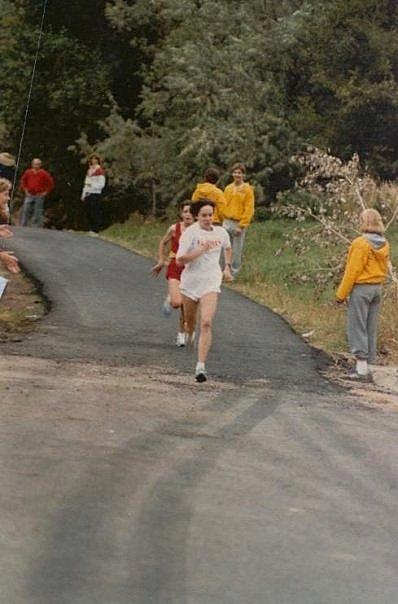
Winning a 5K in high school.


* * *

After speaking to Lori Fitzgerald's mother recently, I felt it was OK to let people know that I used the name Lisa in place Lori. Several other names have been changed throughout this book, but this is one I wanted to share, as Lori was a remarkable and unbelievably kind individual.