Showing posts with label Kevin Beck. Show all posts

Tuesday, March 2, 2021

The Danger of Disagreeing

The other day, I jumped into a discussion on Twitter that addressed Colorado voters and Lauren Boebert, the representative of Colorado's 3rd US Congressional district. Someone tried to put the blame on all residents of Colorado for her winning Colorado's 3rd Congressional District, 51 percent to 45 percent over her closest opponent. I and a few others were trying to explain that the entire state doesn't vote in specific districts and that most residents of Colorado, including many of her own constituents, are unhappy with her representation. Hers is one of seven districts in Colorado, meaning that by definition only about one-seventh of the state's voters even had a say in whether she was elected, and has leaned strongly Republican for many years. 

Someone who couldn't seem to understand this started arguing with me, and, after just a few responses, he went berserk and started posting right and left, calling me a racist and a Nazi. I don't need to prove that I'm neither of these things by explaining my heritage (we're all mutts, as they say) or detailing whom I've dated in the past or who my friends are and have been. It's just a flat-out ridiculous accusation, especially if you consider what I was saying in the thread.

Oddly, or maybe these days not so much, this guy and I have the same general political viewpoint, something he didn't realize until later. His rampage started after I suggested that I and others in Colorado, including some Republican leaders, are not happy that an extreme right, gun-collecting Trump supporter with a shady past is in congress and possibly causing trouble. Claiming that even a significant fraction of Coloradans voted for her, let alone all of them, is like insisting people in Utah are responsible for the city council members elected in Nevada. It just doesn't make sense.

Like many online trolls, Boebert can't take criticism either, much of hers coming from the people who live where she actually was elected. The Twitter troll later put up a poll on his page saying he "got into it" after someone "came at him" and didn't realize he and this person were "on the same side" and had a list of possible actions to take to help him move forward. The whole thing was weird and unsettling, and someone else on Twitter pointed out that the guy's posts tend to be consistently inflammatory. However, the damage was done. Others who don't know me liked his Tweets that called me names without even knowing what the discussion was about. 

But I'm not the only one who experiences this kind of outlandish attack. See, the left extremists have become just as radical and full of hate as those on the right, and they're as quick to stoop to name-calling and lying, sometimes even more so.

Two incidents that occurred on social media recently demonstrate how closed-minded and quick to criticize and exclude others some individuals who claim to accept and even promote diversity are.

In the first incident, a writer, Kevin Beck, posted a piece celebrating diversity and referenced a well-written article in Runner's World. In the blog post, he praised four of the five individuals who were profiled in the RW article and the author herself. It really is a good article. The fifth person profiled in the article is an outlier, someone who has been in a position of both bully and victim and has been caught in at least one lie, among other transgressions. When the blog post caught the attention of people in a Facebook group where the link was posted, several of the members were quick to criticize Kevin rather than his article, one going as far as calling him a "crotchety old white guy." Others poked fun at his use of big words, claiming he uses a thesaurus excessively. 

I know the author and have for a really long time. Comments criticizing his work upset me far more than they affect him at all. That kind of vague criticism of the piece being too long or too wordy reminds me of the "too many notes" scene in Amadeus. For the record, in all the years I have known him, collaborated with him, and spent time with him, I have never, ever seen him use a thesaurus. Whatever you think of his writing style, which of course is not at all the point anyway, the guy's just really fucking smart, and, for whatever reason, I think that upsets some individuals. A few of the same people complaining about the blog post admitted to not having read the whole thing, which makes me wonder why they would take the trouble to comment at all, but everyone likes to be heard, even those who don't have much to say. There were plenty of people who were happy to read the blog post and even agreed with the content. Kevin told me he got more new sign-ups and subscriptions in the days after that post than after anything else he's published, so maybe not everyone has the same amount of trouble with big words.

As unpleasant as it is to see someone I admire and care about being called names, it's far more concerning to see at least one of these critics lie about him. In the thread in the Facebook group, the same individual who was the first to stoop to name-calling also claimed that the blog post was an "article written by a man who has pretty clearly stated over and over again that's he's uncomfortable with so called "social justice warriors" and diversity and longs for the good old days." All of this is a lie in one form or another.  

This same lie has been told off Facebook, too:


Kevin very clearly defines two different types of social justice warriors, one he supports, as he did in his blog post that ultimately caused some friction, and the other he does not because he sees those involved as not being authentic. Regarding the latter, he states, "SJW antics are invariably a power-attention-and-money grab, not earnest activism. This means that fragile alliances and bridge-burnings are inevitable and easily foreseen features of any relationships forged with such people, whether they call themselves influencers or not."

It's laughable, almost, that, regarding a blog post celebrating diversity, the critic wants his audience to believe that the author has stated over and over again that he's uncomfortable with diversity. When pressed, the critic ignored that particular part of his claim and simply went on to say that his usual response is "what I said is valid, so it's not my fault that trolls and bigots are amplifying and repeating it." Notice how quickly he tosses out loaded terms like "bigot," and, as others in the group pointed out, he tried to make something that was about ethics and morality entirely about race. He also accused the host of the Facebook group of treating a black woman differently but offered zero evidence, zero. Meanwhile, the host of the group presented evidence to the contrary. There is also no evidence that the author of the blog post ever made any statements about longing for the past. This accusation is entirely fiction. If you go looking hard enough for something you want to find, though, you will probably eventually find it, even if it's not actually there.

It gets worse. On one of the critic's social media accounts, he posted the content of an argument that unfolded in that same thread but very craftily left out the last few posts to make it look like he had the upper hand, when in fact he did not. 

Omissions like this are another form of lying. It looks like he wants to make it appear like he "won" as if a conversation is some kind of competition, which shows exactly what kind of person he is, not someone who is for inviting a civil exchange of words. Anyone who's into publicly putting down others in such a way that the ones involved aren't invited to reply is not the best example of a model for inclusivity. Then, he has the temerity to suggest that others who don't like Snell's lying and bullying could look the other way and claims, without any proof, that people want her to disappear, yet he looks pretty comfortable making public comments about people he could easily ignore. Why the double standard? 

For someone who talks about wanting to make running spaces inclusive, this individual sure is combative, arrogant, and not truthful -- that is not the best advocate for bringing about harmony in any space at all. Still addressing the string of lies in just that one sentence, the author of the blog post never mentioned the good old days, not in the blog post referenced or anywhere else, for that matter, and the critic never bothered to provide a single example. Whenever a person takes an "I'm right, you're wrong" stance without any evidence at all, there is no room for dialogue. 

People can criticize Kevin's flowery language and lengthy posts, but the truth is that he's bringing up topics that many others are too afraid to discuss, most likely because bullies and trolls who claim to be woke come out in droves to insult anyone with an opposing opinion. Fortunately, Kevin's skin is thick, so bullies and general critics who either don't bother to read the content, make assumptions about it without reading for comprehension, or just plain lie about him don't affect his drive to address difficult topics. 

The other incident involved a tweet criticizing an individual, the same ACLU lawyer I have mentioned before, for lying. The one posting about the lawyer was immediately called homophobic and a bigot, and only one person asked for more information before defending the lawyer who lied, claiming he had done great things. That may be so, but he has also attempted to damage the reputation of several people simply for voicing their opinions, and, again, he hasn't always been operating above board. This kind of scenario is the perfect example of shooting the messenger. 

Here's my problem with all of this. Online debate, even bickering, is one thing, and I think most people like the idea of a healthy or lively discussion. The hosts of the Keeping Track podcast, Alysia Montano, Molly Huddle, and Roisin McGettigan, do an excellent, really outstanding job of encouraging conversation. They are shining examples of how the running community can become more inclusive. In stark contrast to these women and others who actually invite a civil back-and-forth, are those who can't control themselves and immediately call others racists, Nazis, and bigots throw out some serious accusations, often without merit, and, in turn, look more like fanatics than those whom they are attacking. 

It's uncalled for to drag out such potentially damaging smears when simply expressing an opinion is an option. Not that long ago, an American was sued when he called some German officers Nazis because he was upset, not because they were acting like anything other than officers. Certain words shouldn't be used simply because a person is pissy. "Wah, I'm mad so I'm going to slander your name and attempt to ruin your reputation." What an awful approach to life. But that's where we are, and the more people respond to their unchecked anger with a string of hateful insults, the more division it will cause. 

Tricia Griffith of Web Suleths says that nobody should be allowed to make false accusations against another person and attempt to tear a person's life apart, but, for the most part, it's legal. You can call someone a racist, bigot, or Nazi online with little to no repercussions. I know this doesn't matter to those who live in a small online bubble among like-minded individuals who like to see bullies attack anyone, no matter the reason, but these types of bullies will lose potential allies because of their bad behavior. 

Tuesday, September 19, 2017

Quick Clarification

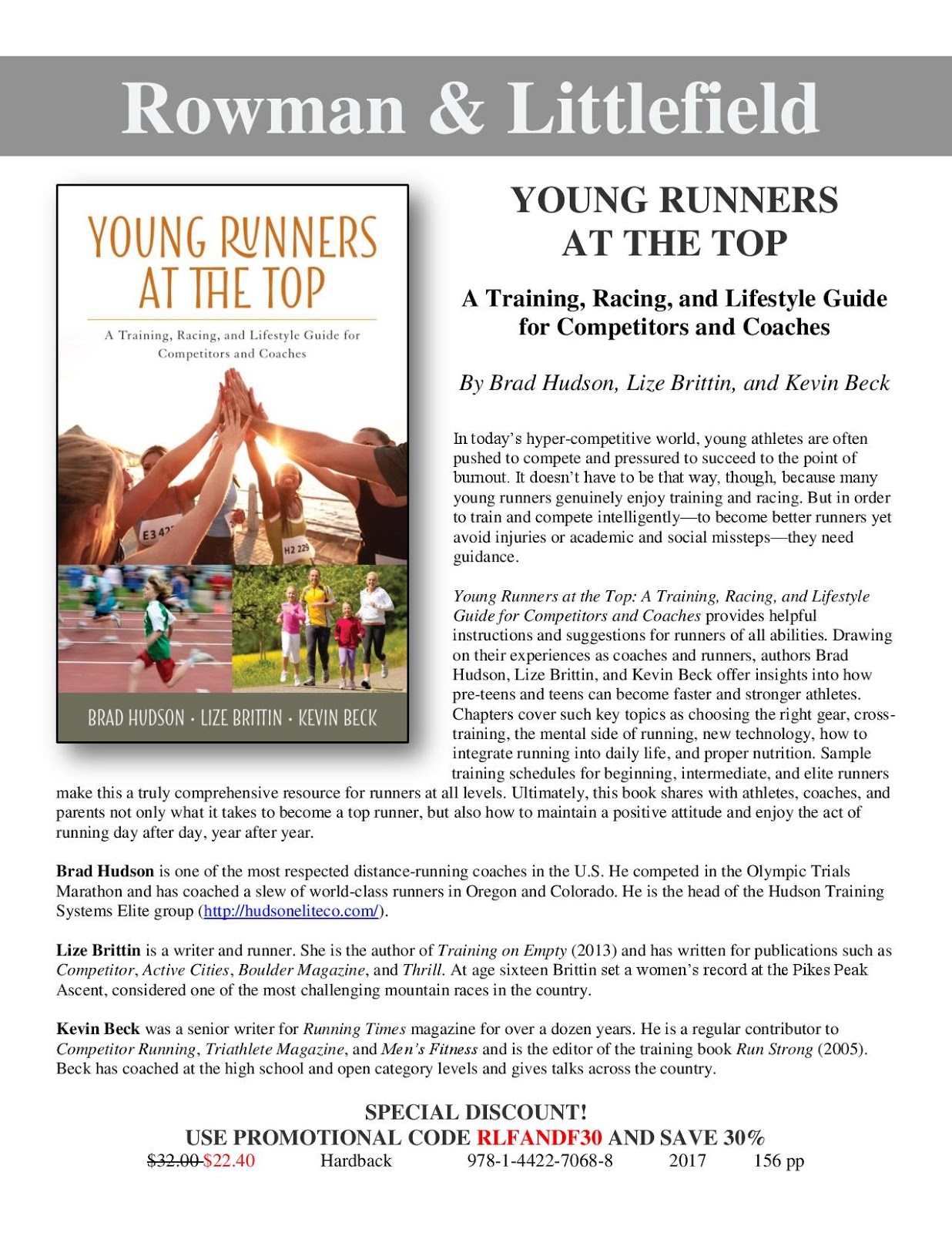
Kevin Beck, Brad Hudson and I recently attended an event at the Boulder Book Store and had the opportunity to discuss our book, "Young Runners at the Top." A few questions from audience members brought up some differing opinions about training and coaching, so I wanted to address at least one of the topics here.

The concept for "Young Runners at the Top" started quite a while ago when Suzy Hamilton and I decided to write a book focusing on young athletes. We felt there were training books written for little kids and those for adults, but those addressing teens who want to compete successfully at a high level were lacking. She wasn't able to continue with the project, so I asked Melody Fairchild to get involved, which she was happy to do until a new coaching opportunity prevented her from having enough time.

In the end, this was somewhat of a community undertaking. I and my coauthors are grateful to all the people who helped create "Young Runners at the Top." The list of people involved includes but is not limited to:

Addie Bracy, Mark Plaatjes, Bobby McGee, Dr. Richard Hansen, Lucy and Nerida Alexander, Bean Wrenn, Melody Fairchild, Ruth Waller, Scott Fry, Greg Weich, Carrie Messner-Vickers, Róisín McGettigan-Dumas, Barb Higgins, Suzy Favor Hamilton, Rebecca Walker and Lorraine Moller.


During our first book signing event, Brad, Kevin and I addressed some important topics. We spent a long time talking about why so few young girls who run well during high school go on to compete at a high level in and after college. Obviously, it doesn't come down to one issue. Some contributing factors include transitioning through puberty; social, peer and self-imposed pressure that leads to increased and prolonged stress; and overtraining and burnout. Our book offers ideas on how to help young runners transition through these difficult times and continue running into adulthood.

While discussing these issues, people used many examples and comparisons, which doesn't resolve or accomplish very much. You can't use others as examples of the proper weight or take a training plan for one person and successfully apply it to someone else without knowing a whole lot about both. When using elite athletes as an example, you never know exactly what methods they use to achieve their success. They often offer a very minimal and possibly skewed glimpse into their lives, so it's easy to make assumptions about what might or might not be occurring. One thing the three of us suggested in "Young Runners at the Top," is to always individualize training programs and diets for each athlete. I'm not sure if we made that clear enough at the event, so I wanted to reiterate it here.


The other issue I wanted to address is weight. Some jokes were made about runners being thin, but ultimately you can't be a healthy runner and have a long and successful career if you are not fueling yourself properly. I have already posted about the seductive grace period and weight loss, so I won't go into it again here. Suffice to say that coaches need to be thinking about their athletes moving through different phases of training and competition in the healthiest way possible, and starving won't allow for longevity in the sport.


Tuesday, April 18, 2017

Collateral Damage

For a few years now, I have been debating whether or not to write about an issue in my life. It's not my issue per se, but it affects me a great deal, especially more recently. I've tried to ignore it or take the high road by simply sitting back and doing nothing, but that became increasingly harder to do in the last few weeks. I'm putting this out there because I'm tired. The strange and escalating online behavior of an individual has gone past shocking to worrying me, and I'm really sick of saying nothing about it and pretending it's OK. It's not. When I write this all out, I assume it will look like the shenanigans of kids in middle school, but when this stuff happens in the adult world, it's unsettling.

In 2009, I *met* a woman through a mutual friend on Facebook. It was actually my boyfriend, Kevin, who introduced us. He had started coaching her sometime in October of that year, and, despite my initial first impression and a sense of uneasiness, we friended each other the following month. This woman and I had a few online chats and occasionally commented on each other's social media posts. Though she confided in me about a few of the issues she was facing at the time, I felt the need to keep my guard up and never really opened up to her, something I'm glad about now. By the summer of the following year, she seemed to want to keep her distance, and I was fine with that. From what I could gather, she was preoccupied with a guy. Our communications ended, and the only real tie that linked us together was Kevin. You can read his recap of events here.

Sometime in 2010, Kevin asked if I had been saying things about him to this woman or to anyone else. Apparently, she told him that I and one of Kevin's ex-girlfriends had been saying some unkind things about him. Both his ex and I denied having said anything, and this was enough for me to realize his client was not someone with whom I wanted to socialize. I quickly blocked her on Facebook and other social media websites. I assumed I would never have to deal with any of these kinds of antics from her again. Out of sight, out of mind seemed appropriate, in theory anyway. Unfortunately, I was wrong.

Long before she and Kevin began having issues, I found out that she had tried to convince Kevin to lock me out of the house where we were staying. It's true that Kevin and I had our ups and downs and were in a down spell at the time, but I still find it odd that someone I hardly knew and still hardly know, and someone I had made every effort to be kind to, would suggest something like this. He didn't, of course. When she and Kevin had their first falling out, I wasn't surprised, and when she came back to him later and requested that he coach her once more, I and many of his friends gently warned him that it might not be in his best interest to take her on as a client again. When their second falling out occurred, it also wasn't a surprise, but what happened after that was, at least the severity of it was. When things seemed more than a little bit out of hand, at least from my perspective, I tried to encourage Kevin to go to the police, but he didn't think the police could really do anything and didn't think things would continue. They did.

Things turned ugly after the second falling out, and she took many opportunities to complain about Kevin online, sometimes anonymously on Let's Run and sometimes on her blog or on social media. When he finally responded, she went off the deep end to the point where Kevin ended up in a hearing after she filed a petition for a restraining order that was filled with something other than facts. The hearing was bizarre. Kevin purchased a recording of it that's now in my hands. To me, it seemed like the judge was aware that not everything was adding up, and toward the end of the proceedings, he said that he felt Kevin's former client was doing and saying these things in an effort to make Kevin look like a bad person. He also said that Kevin could take her to court for defamation of character and for lack of payment, but it was a hearing only and didn't address those kinds of issues. At one point, the judge turned to her and said, "I suggest that you do not post anything publicly about Mr. Beck online..." He added that he felt it was best that the two of them leave each other alone. Her response was to go home and immediately post something publicly online about Kevin, and he is no longer quiet about pointing out her inconsistencies.

Since then, she has continued to take both direct and indirect swipes at Kevin; me; our coauthor, Brad; many of Kevin's friends; anyone living, coaching or training in Boulder; people with eating disorders (how we are stupid); and at Boulder in general. Oh, what a crummy place it is to be. I'm pretty sure Kevin is no longer going to let any of her attacks slide, which is understandable considering nothing seems to work to stop her, not even a judge suggesting she do just that.

Some of the more hurtful comments she has said about me include stating outright that I haven't eaten since high school, that I have "huge problems", that I'm a "legendary anorexic" who is in no position to coach, that I enable or even go on drinking benders with Kevin (I barely touch alcohol!) and, the worst, that I'm basically using my mom, counting on her dying, so that I can inherit her house. This last one is bogus, of course, but because I'm very close to my mom and love her dearly, it bothers me more than the others that show more about who she is as a person than about who I am. People who know me know the kind of person I am. I'm not worried about that. I'm very fortunate to have some incredible people in my life. There have been other mean-spirited remarks about me, but the gist is always the same, that I'm washed up, a failure, don't have a good job, that I'm a victim of domestic abuse etc.

I've never hidden the fact that I struggled with an eating disorder that nearly killed me, more so in the past, but I have put it out there in an effort to help others and let people know that it's OK to struggle. We are not our illnesses. She can rip on that all she wants, but to bring my very kind, very able-bodied, older mother into things is hitting pretty damn low. She tried to claim that Kevin somehow manipulated or edited these tweets, but I got them directly from her twitter feed:


Kimberly Duclos boulder runner
This isn't directed at me, but my mother and I are collateral damage.

Kimberly Duclos twitter
More of the same kinds of tweets by Kimberly Duclos.

Though something like the tweet below, as absurd as it is, isn't directed at me in particular, it's directed at runners who have some type of an eating disorder, and I fall or have fallen into this category, as do many others, I would guess, especially if you take a broad definition of eating disorders and don't limit it to anorexia, bulimia and binge eating:

Kimberly S Duclos Boulder
Another odd remark from Kim Duclos.


I don't know. This is something I will never quite understand. In general, I try very hard to be a decent person. I'm not perfect, but I do my best to be helpful, kind, compassionate and considerate. In this case, I'm really not sure how to handle it. Doing nothing and looking the other way hasn't helped. If anything, things have gotten worse.

It's possible that there is some hurt under all these outbursts. I think it's misdirected at me, but I know that finding your true identity as a runner can be difficult. It might be that the falling out with Kevin, a coach who helped her reach some pretty lofty goals in running, caused some conflict in her mind. The coach-athlete relationship, good or bad, can be a hard one to let go of, but this is a lot of speculation on my part. I don't know enough about the situation to make any solid conclusions. There may be deeper issues at play, too. All I know is that I want all this bullshit to stop. Whatever grudge she has against him or, for whatever unknown reason, me, I just want her to go live her life and be as happy as she claims to be in between venomous bouts of tweeting or posting my name on Let's Run, Twitter or Facebook. There's no need to constantly and relentlessly drag other people into this fight. These kinds of attacks are so unnecessary and so very cruel. I may be expanding the scope of conflict by posting this, but my intent is to stop pretending like this shit doesn't affect me. It does. It's upsetting and weird and even a little bit scary. 

And obviously, this is my perspective. Again, I don't know this woman and have no idea why I am so often the brunt of her online remarks or even why Kevin is. All I know is that I want out of this situation and really hope something will eventually help her stop lashing out and move on with her life.  


Monday, July 25, 2016

Training on Empty: Chapter 16 (Possible TW)

Possible trigger warning with mention of behaviors and numbers.


Chapter 16 – Males and Eating Disorders


“My theory is that men are no more liberated than women.” – Indira Gandhi


It's rare to think of a man when the topic of eating disorders comes up, but women are not the only ones who suffer. It’s much more common for men to confess to binge-eating than to any other eating disorder, but that doesn't mean that they are immune to other eating issues. Over thirty percent of binge-eaters are male. Eating disorders in general are starting to be more recognized in men, especially gay men, who make up the majority of males with eating disorders at this point or are at least more willing to admit to having one. Many gay men already worry about prejudice and discrimination as a result of their sexual orientation, and added to this burden is the fear that their peers will judge them in terms of their weight. The term “gay fat” emerged to describe a gay man who could be seen as normal in size by most, but fat in the eyes of other gay men. Within the gay culture, there is so much pressure to be perfectly toned and lean that many men are developing an abnormal focus on their bodies and falling into disordered eating patterns. Though gay men are more likely to seek treatment than men in general, they are also developing eating disorders and body dysmorphic disorder – a condition in which people become preoccupied or obsessed with a perceived flaw in their appearance – at an alarming rate. Even though gay men are more often diagnosed with eating issues, they are not the only ones affected.

Many people agree that anorexia in men may be under-diagnosed, and there are several reasons for this. Often, physicians will not recognize the illness in a man owing simply to the false assumption that anorexia is a women’s disease. According to the article “Eating Disorders in Men” by Margarita Tartakovsky, M.S., most of the diagnostic criteria for anorexia focus on women. Typically, doctors look for amenorrhea and a fear of fatness. However, men’s symptoms can differ greatly from those of women. For example, while most women report a fear of getting fat or feeling fat, men might express the desire to be more muscular and still suffer from the disorder. Just as there is societal pressure for women to conform to a certain body type, the pressure on men to look a certain way is becoming more apparent as well. Lately, there has been an increase in men seeking plastic surgery such as pectoral implants, calf implants and liposuction. More often than not, men keep quiet about their struggles with food, which leads others to assume that there isn’t a real problem or the problem is not severe. Obsessive exercise is common in men who suffer from anorexia. Because there are sports in which low body weight is acceptable, men who engage in these sports can rationalize that their low body weight is not an issue.

Dave Dunham, a renowned road, mountain and snowshoe racer and a recovered anorexic, admits that it’s often harder for men to open up about eating disorders. He says that “there is a societal expectation for men to be tougher and not really talk about problems.”

Dave’s issues began after college, when his weekly mileage was increasing and his weight was decreasing. While some people exercise in order to work off calories already consumed, Dave exercised in order to give himself permission to eat. “I started running triples – three runs a day,” he says. “I think this is when things really started to snowball. I didn't like running within a few hours of eating, so it became difficult to find a time to eat. Somewhere along the line, instead of eating to run, I was running to allow myself to eat. If I didn't run long enough or hard enough, I felt I didn't deserve to eat. Eventually, I got to the point where I was not eating, except for dinner. This kept the illusion that nothing was wrong. My doctor had been encouraging me to get help for a couple of years, but I kept saying that despite knowing I had a problem, I wasn't ready to do anything about it. At 5’7”, I was down to 115 pounds and injured when I finally decided that it was time to get help. I bottomed out weighing less than 110 pounds and finally got into an eating disorder program.” Fortunately, Dave has recovered from his illness. He no longer uses his training to feel okay about eating. To anyone struggling with an eating disorder, especially anorexia, Dave recommends throwing out the scale and eating a variety of foods.

Though reluctant to admit it, men also suffer from bulimia. When I was a young runner, I met a top mountain runner who told me years later that while he was racing and training, he had bulimia. He would not go into detail about his illness or how he eventually overcame it, but he did say that the pressure of running, racing and wanting to be thin contributed to the purging cycle.

Kevin Beck, a running coach and former sub-elite marathon runner, developed bulimia during his freshman year in college. He believed that there was such a stigma for men to admit having an eating disorder that he kept it a secret for years, though he says that he feels that he would have studiously guarded his secret even had he been female. It wasn’t until he was much older that he was able to finally confess that he had a problem despite sensing those around him, especially his mother, suspected that he had issues.

Kevin admits that the illness isolated him, chiefly in a psycho-emotional sense but sometimes literally. His social life was compromised during periods of extreme binging and purging, as for all intents and purposes he was in the throes of an addictive drug at such times. For him, bulimia became a way to cope. It was an easy “solution” to always fall back on when something seemed difficult or he got overwhelmed with emotion, good or bad.

Kevin cautions anyone struggling to talk about it with someone. Even just admitting out loud that he had a problem seemed to help. It took the power out of the illness to some extent. “I wish I had said something. It’s so shame-based,” he says. “I wish guys would be able to talk about how they feel and express when they feel isolated and emotionally burdened. It would help dissolve internal conflict.”

As far as actual symptoms, it has been reported that men and women suffer similar rates of accompanying unhappiness, anxiety, depression, self-injury and substance abuse. In addition to the bulimia, Kevin has also struggled with alcohol abuse. In general, co-existing addictions are more common in bulimics than in anorexics. Kevin attributes this to bulimics having poor impulse control, while anorexics tend to exert too much control. Samuel S. Lample, in his article “Eating Disorders: Not just a women’s problem,” reports that a study of 135 male eating-disorder patients revealed that across all diagnoses, 37% had a comorbid substance use problem, with alcohol abuse the most common problem (seen at a rate roughly three times that of cocaine abuse.) More specifically, Lample notes, 61% of patients with bulimia had a co-occurring substance abuse problem, and that they were three times more likely to have this problem than anorexic men.

In the same article, Lample suggests that those with bulimia show decreased prefrontal cortex brain activity but increased activity in the limbic system. This combination potentially leads to poor judgment and possible emotional problems. Writes Lample: “The strong food cravings common in those who binge eat, are linked to the brain's hedonic system, which regulates risk-taking and novelty-seeking behaviors, self-control, and pain avoidance. In short, bingeing behaviors can be seen as resulting from problems in the hedonic system around impulse control.”

Despite the hope that he would one day simply outgrow the illness, Kevin still struggles with it today. Bulimia has taken its toll on him both emotionally and physically. The continual throwing up throughout the years has caused his teeth to erode, and a computerized tomography (CT) scan has shown that his brain, almost certainly as a result of alcohol, resembles that of a much older person. Kevin feels that without getting to the root of his problems, he won’t be able to find better ways to cope. He can go years without binging and purging or years without drinking, only to relapse. Because Kevin understands the illness so well, he has, despite not being able to help himself, been able to offer help to others. He feels that early detection is the key to a less traumatic and more complete recovery.


* * *

Wednesday, April 22, 2015

TOE3- Interview with Kevin Beck

Interview with Kevin Beck:


For more information about Kevin, please visit his website at www.kemibe.com

Kevin Beck